Strengthen Cybersecurity: Calysto IT Risk Audit
Cybersecurity, IT Risk Management, Business Continuity
The Calysto IT Risk Audit:
A 5-Layer Framework to Strengthen Your Cybersecurity Posture
For most businesses and agencies, technology risk is no longer an abstract concern. It shows up as downtime, wire fraud, ransomware demands, or a panicked call from a client whose data might be exposed. The challenge is not knowing that IT and cybersecurity matter—it’s knowing where you actually stand today and what to fix first. That’s exactly what the Calysto IT Risk Audit is designed to answer, using a clear, five-layer framework that any leadership team can understand.
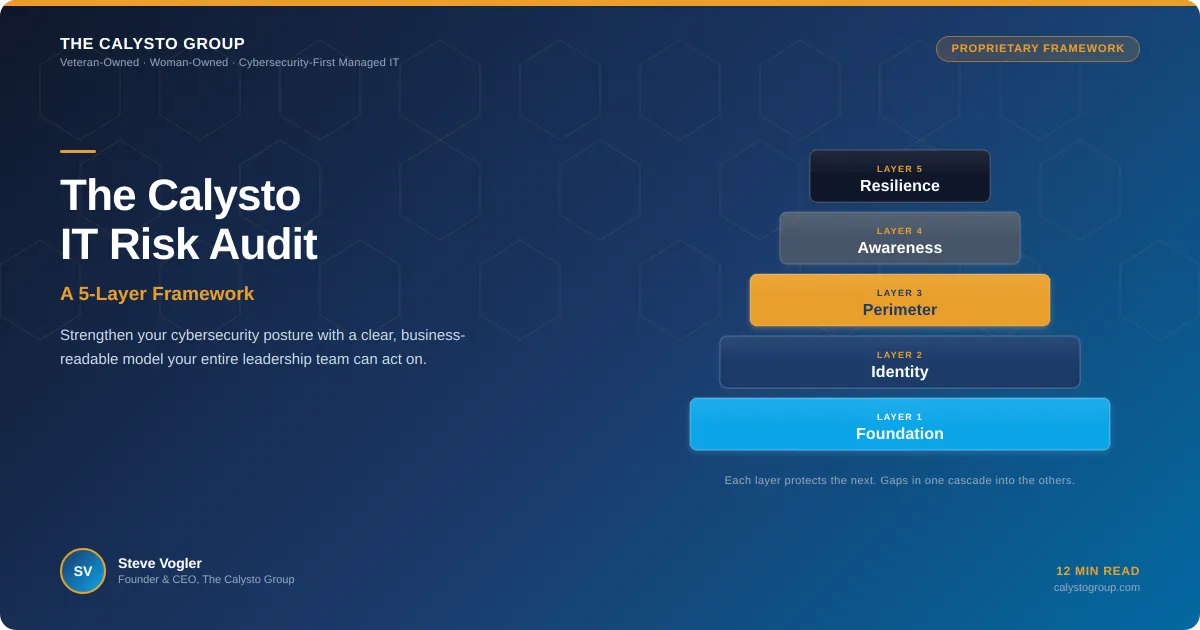
Calysto’s proprietary 5-layer IT Risk Audit evaluates your environment across Foundation, Identity, Perimeter, Awareness, and Resilience. Each layer looks at specific controls, identifies the most common gaps we see in organizations like yours, and maps those gaps directly to business impact—lost revenue, regulatory exposure, operational disruption, and reputational damage. The result is a prioritized roadmap that aligns cybersecurity with business outcomes, not just technical checklists.
Why a Layered IT Risk Framework Matters to Business Leaders
Cybersecurity conversations often get lost in jargon: EDR, SIEM, SASE, zero trust. The Calysto IT Risk Audit takes a different approach. By organizing risk into five intuitive layers, it creates a shared language for executives, operations, finance, and IT to talk about the same problem from different angles. Instead of debating tools, you can see:
Where your biggest exposures actually are—not just where you’ve invested the most money.
How gaps in one layer cascade into others, turning small weaknesses into major incidents.
Which improvements deliver the greatest business value in terms of uptime, compliance, and client trust.
Below, we’ll walk through each of the five layers—what Calysto evaluates, the most common gap we uncover, and the business outcome when you get that layer right. Use this as a lens to evaluate your own environment, and as a preview of what the full Calysto IT Risk Audit can deliver.
Layer 1: Foundation — The Operational Bedrock of Cyber Resilience
The Foundation layer focuses on the everyday operational controls that quietly keep your business safe: backup, patching, and endpoint protection. These are not glamorous, but they are the difference between a minor inconvenience and a full-blown crisis when something goes wrong—as it inevitably will. Calysto starts here because if the basics are weak, everything built on top of them is at risk.
What Calysto Evaluates at the Foundation Layer
Backup strategy and execution: frequency, retention, offsite copies, immutability, and recovery testing for servers, cloud workloads, and critical SaaS data (email, documents, line-of-business apps).
Patching and update management: coverage across servers, workstations, laptops, network devices, and applications; patch cadence; and how quickly known critical vulnerabilities are remediated in practice, not just on paper.
Endpoint protection: antivirus/EDR tooling, configuration, alert handling, and whether all endpoints—including remote and BYOD—are consistently protected and monitored.
The Most Common Foundation Gap Calysto Finds
Across industries, the most common Foundation gap is a false sense of backup security. Many organizations believe they are fully backed up, but Calysto’s audit often reveals that:
Only some systems are covered, leaving critical applications or cloud data unprotected.
Backups are never tested, so recovery times and data integrity are unknown until disaster strikes.
Backups can be encrypted or deleted by the same ransomware that hits production, because they aren’t isolated or immutable.
The result is a dangerous gap between what leaders assume is protected and what actually can be restored within an acceptable timeframe.
Business Outcome of Getting the Foundation Right
When your Foundation is strong, you can absorb incidents without catastrophic disruption. Ransomware becomes a recoverable event, not a business-ending one. Patch discipline closes the door on opportunistic attacks that exploit known vulnerabilities. Endpoint protection stops or contains threats before they spread. Financially, this translates into:
Reduced downtime and revenue loss during incidents.
Lower remediation and forensic costs after an attack.
Stronger positioning with cyber insurers and regulators who now expect these basics to be in place.
📌 Key Takeaway: If you can’t confidently say exactly what you could restore, and how fast, after a major outage, your Foundation layer needs attention before you invest in anything more advanced.
Layer 2: Identity — Protecting Who Has Access to What, and Why
Once the basics are in place, the next critical layer is Identity: how you manage users, accounts, and access to systems and data. In modern attacks, stolen or abused credentials are often the entry point. Calysto evaluates how your organization handles MFA, access management, and offboarding to determine whether you’re truly controlling who can do what inside your environment.
What Calysto Evaluates at the Identity Layer
Multi-factor authentication (MFA): where it is enforced (email, VPN, remote access, privileged accounts, cloud apps), how it’s configured, and whether there are legacy or “exception” accounts without MFA.
Access management: role-based access controls, least-privilege principles, periodic access reviews, and how new access is requested, approved, and documented.
Offboarding and account lifecycle: how quickly accounts are disabled when employees, contractors, or vendors leave, and whether shared or service accounts are tracked and managed.
The Most Common Identity Gap Calysto Finds
The most frequent Identity gap is inconsistent MFA coverage and weak offboarding. Organizations may have rolled out MFA for email, but:
Remote access tools, admin portals, and third-party systems still allow single-factor logins.
Former employees retain access to cloud apps or data because there’s no unified offboarding checklist or HR–IT coordination.
Shared passwords (for social media, banking, or vendor portals) live in spreadsheets or emails, with no audit trail of who used them and when.
These gaps give attackers and disgruntled insiders exactly what they want: a legitimate, trusted identity to move freely inside your environment.
Business Outcome of Getting Identity Right
When Identity is well-managed, you dramatically reduce the risk of account takeover and unauthorized access. Strong MFA, clear roles, and tight offboarding mean:
Fewer successful phishing and credential stuffing attacks leading to wire fraud or data theft.
Better compliance with regulations and client security requirements that now mandate MFA and access controls.
Stronger internal accountability—leaders know who can access sensitive data, and why.
💡 Pro Tip: Ask your team to list every system where MFA is required today. If the list is incomplete or inconsistent, your Identity layer is exposing more risk than you think.
Layer 3: Perimeter — Securing Email, Networks, and Remote Access
The Perimeter layer covers the front doors and windows of your digital environment: email security, network controls, and remote access. Even as work has moved beyond a traditional office network, attackers still rely heavily on email and exposed services to gain a foothold. Calysto evaluates how well your perimeter keeps bad actors out, and how it limits their movement when they do get in.
What Calysto Evaluates at the Perimeter Layer
Email security: spam and phishing filtering, attachment and URL scanning, impersonation protection, and domain protection (SPF, DKIM, DMARC) to prevent spoofing and business email compromise (BEC).
Network controls: firewalls, segmentation, intrusion detection/prevention, and how access is restricted between internal systems, guest networks, and cloud environments.
Remote access: VPNs, remote desktop tools, third-party access, and whether these are secured with MFA, logging, and least-privilege principles.
The Most Common Perimeter Gap Calysto Finds
At the Perimeter, Calysto most often uncovers aging or ad-hoc remote access and email protections. Typical issues include:
Legacy remote desktop tools exposed directly to the internet, sometimes without MFA or modern encryption.
Incomplete email authentication (no DMARC, or weak enforcement), making it easier for attackers to impersonate executives or vendors.
Flat networks where a single compromised device can see and reach far more systems than necessary.

Tight perimeter controls turn constant background threats into manageable, contained events.
Business Outcome of Getting the Perimeter Right
When your Perimeter is strong, you reduce the volume and severity of attacks that ever reach your users or systems. Fewer malicious emails land in inboxes, fewer exposed services are available for attackers to probe, and compromised devices are limited in what they can access. For the business, this means:
Fewer security incidents escalate into full-blown breaches or outages.
Lower risk of high-impact fraud scenarios like invoice redirection or executive impersonation.
Greater confidence in supporting remote and hybrid work models without sacrificing security.
📌 Key Takeaway: The Perimeter layer is where many attacks start. Strengthening it not only protects you, it also reduces the daily noise your IT team has to manage.
Layer 4: Awareness — Turning Your People into a Security Asset
Technology alone cannot secure a modern organization. The Awareness layer focuses on your people: how they think about security, how they respond to suspicious activity, and whether they feel responsible for protecting the organization. Calysto evaluates your training, phishing simulations, and overall culture to determine whether your workforce is your first line of defense—or your biggest vulnerability.
What Calysto Evaluates at the Awareness Layer
Security awareness training: frequency, content relevance, role-specific modules (for finance, HR, executives), and how engagement and completion are tracked.
Phishing simulations: how often they are run, how realistic they are, how results are reported, and how coaching is delivered to high-risk users or departments.
Security culture: whether employees know how to report suspicious activity, how leadership talks about security, and whether mistakes are treated as learning opportunities or hidden out of fear.
The Most Common Awareness Gap Calysto Finds
The recurring Awareness gap is one-and-done training with little reinforcement or measurement. Many organizations can show that employees completed an annual course, but Calysto’s audit often reveals that:
Phishing simulations are rare, predictable, or not tied to coaching and improvement plans.
High-risk teams (such as finance or executives) are not receiving tailored training for the threats they face most often.
Employees are unsure how to report suspicious emails or incidents, or fear being blamed if they make a mistake.
The result is a workforce that checks the compliance box but is not truly engaged in protecting the organization day-to-day.
Business Outcome of Getting Awareness Right
When Awareness is strong, employees become an active part of your detection and defense system. They pause before wiring funds, verify unusual requests, and quickly report suspicious emails or behavior. This leads to:
Fewer successful phishing and social engineering incidents reaching the point of financial or data loss.
Faster detection of compromised accounts or devices because employees speak up sooner.
A culture where security is seen as part of doing business well, not as an IT-imposed burden.
💡 Pro Tip: Look at your last few security incidents. How many could have been prevented or caught earlier if someone had been more aware or felt safer speaking up?
Layer 5: Resilience — Preparing to Respond, Recover, and Communicate Under Pressure
Even with strong controls across the first four layers, incidents will still happen. The Resilience layer examines how well your organization can respond, recover, and continue operating when something goes wrong. Calysto evaluates your incident response planning, business continuity, and cyber insurance alignment to determine whether you’re prepared for the worst day—not just the best case.
What Calysto Evaluates at the Resilience Layer
Incident response (IR): existence and quality of IR plans, defined roles and responsibilities, escalation paths, communication templates, and whether tabletop exercises or simulations have been conducted with leadership involvement.
Business continuity and disaster recovery: documented recovery time objectives (RTOs) and recovery point objectives (RPOs), failover strategies, and how IT dependencies are mapped to critical business processes and client commitments.
Insurance alignment: cyber policy coverage, exclusions, incident reporting requirements, and whether your technical controls and documentation support a successful claim when needed.
The Most Common Resilience Gap Calysto Finds
The most frequent Resilience gap is plans that exist on paper but have never been tested or aligned with reality. Calysto often finds that:
Incident response plans are outdated, unpracticed, or unknown to the people who would actually execute them.
Business continuity assumptions (like “we can be back up in four hours”) are not supported by backup, infrastructure, or staffing realities.
Cyber insurance policies are not fully understood, and required controls or documentation are missing—creating risk of denied or reduced claims.
In a crisis, these gaps turn what could have been a controlled incident into a chaotic scramble, with executives, IT, legal, and communications all improvising under pressure.
Business Outcome of Getting Resilience Right
When your Resilience layer is mature, you can manage incidents with confidence and credibility. Leadership knows who is in charge, who to call, and what to say to clients, regulators, and the media. IT knows which systems to prioritize and how to restore them. Insurance partners see you as a prepared, lower-risk client. Concretely, this leads to:
Shorter, more predictable downtime and clearer communication to customers and stakeholders.
Reduced legal, regulatory, and reputational fallout because you can demonstrate due diligence and a structured response.
Better financial outcomes from insurance claims, thanks to aligned controls and documentation.
📌 Key Takeaway: Resilience is not just an IT issue; it’s an executive responsibility. Your response on your worst day will shape how clients and regulators see you for years.
How the Calysto IT Risk Audit Brings the Five Layers Together
Each of the five layers—Foundation, Identity, Perimeter, Awareness, and Resilience—matters on its own. But the real power of the Calysto IT Risk Audit comes from seeing how they interact. A weakness in one layer often amplifies risk in another. For example:
Weak Awareness (employees clicking phishing emails) combined with weak Identity (incomplete MFA) dramatically increases the odds of account takeover and fraud.
Strong Perimeter controls lose much of their value if Foundation backups are untested and Resilience planning is unpracticed—an incident may still cripple operations.
Solid Identity management can be undermined by poor offboarding and shared passwords, which Calysto often surfaces when cross-checking HR and IT records.
Calysto’s framework doesn’t just score each layer in isolation. It identifies cross-layer dependencies and translates them into a business-focused action plan:
Clear, prioritized recommendations, ranked by impact on risk reduction and operational continuity.
Visual heat maps that show executives where to invest next and what “good” looks like at each layer.
A roadmap that aligns IT initiatives with regulatory requirements, client expectations, and insurance demands.
💡 Pro Tip: Use the five layers as a standing agenda for quarterly security reviews with leadership. It keeps conversations grounded and progress measurable.
Your Next Step: Self-Assess Today, Audit for Clarity Tomorrow
If you’re a business or agency leader, you don’t need to become a cybersecurity expert—but you do need a clear picture of where your organization stands. The Calysto IT Risk Audit is built to give you that clarity in a language the entire leadership team can act on. Whether you’re preparing for a regulatory review, renewing cyber insurance, responding to client security questionnaires, or simply trying to sleep better at night, understanding your five-layer posture is a powerful starting point.
You have two practical ways to move forward:
Take the Calysto IT Risk Self-Assessment. In a short, guided questionnaire, you’ll score your organization across the five layers and receive a high-level summary of strengths, weaknesses, and quick wins. It’s a low-friction way to start the conversation internally and to benchmark where you stand against peers.
Book the full Calysto IT Risk Audit. For organizations that need a deeper, evidence-based review, the full audit provides detailed analysis, documentation, and a prioritized roadmap tailored to your business model, regulatory landscape, and growth plans.
In both cases, you move from vague concern—“We hope we’re secure”—to a structured understanding of your Foundation, Identity, Perimeter, Awareness, and Resilience. You’ll know where you are today, what “good” looks like for an organization like yours, and what steps will deliver the most meaningful reduction in risk and disruption.
Cyber threats are not slowing down, and neither are the expectations of clients, regulators, and insurers. But with the right framework and a trusted partner, you can turn cybersecurity from a constant source of anxiety into a manageable, strategic advantage. The Calysto IT Risk Audit gives you that framework.
Ready to see your true IT and cybersecurity posture? Start with the Calysto IT Risk Self-Assessment to get an immediate snapshot, or book the full Calysto IT Risk Audit to gain a comprehensive, actionable roadmap for strengthening every layer of your defenses. Your future clients, partners, and employees are counting on the decisions you make today.