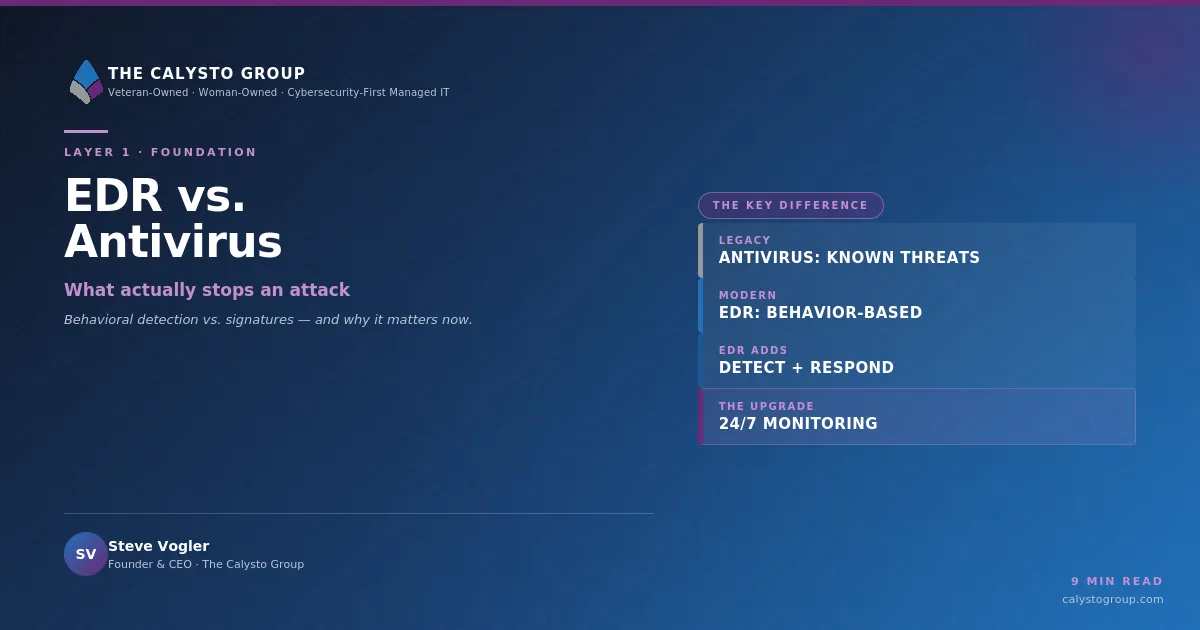
EDR vs. Antivirus: What Actually Stops an Attack
If you ask most business owners what protects their computers, the answer is antivirus. It is a familiar word, it has been around for decades, and it feels like a settled question. For a long time it was.
It is no longer. The way attacks work has changed, and the protection that made sense fifteen years ago now leaves a meaningful gap. Understanding the difference between traditional antivirus and what has replaced it — endpoint detection and response, or EDR — is one of the more consequential technology decisions a business will make, even though it rarely gets discussed at the leadership level.

How traditional antivirus works
Traditional antivirus works by recognition. It maintains a list of known threats — a catalog of the digital fingerprints of malware that security researchers have already identified — and it scans your files against that list. If it finds a match, it blocks the file. If it does not find a match, the file is allowed.
This is a signature-based approach, and for its era it worked well. When most malware was a known quantity circulating widely, checking against a list of known-bad fingerprints caught the majority of it.
The weakness is built into the model. Signature-based antivirus can only catch what it already recognizes. A brand-new threat that no researcher has cataloged yet has no signature, and so it passes straight through. And modern attackers specifically design their tools to be unrecognizable — subtly altered for each target so that no existing signature matches. Against that approach, a recognition-based defense is always one step behind.
How EDR works differently
Endpoint detection and response takes a fundamentally different approach. Rather than asking “do I recognize this file,” it asks “is something behaving the way an attack behaves.”
EDR watches what is actually happening on a device — the processes running, the files being changed, the network connections being made — and looks for the patterns of malicious behavior. An attack does not need a known signature to be caught, because it is identified by what it does rather than what it is. When a process suddenly begins encrypting files rapidly across the system, EDR recognizes the behavior of ransomware and can stop it, even if that specific ransomware has never been seen before.
Antivirus asks whether it recognizes the threat. EDR asks whether something is behaving like a threat. In 2026, that difference decides outcomes.
— Steve Vogler, Founder & CEO
The “response” half most people miss
The name is endpoint detection and response, and the second word carries as much weight as the first.
Traditional antivirus detects and blocks, and that is the end of its job. EDR adds the ability to respond. When it identifies a threat, it can isolate the affected device from the network to stop the spread, terminate the malicious process, and preserve a detailed record of what happened for investigation. That record matters enormously, because understanding how an attacker got in is what allows you to close the door they used.
This response capability is the difference between “one machine had a problem and we contained it in minutes” and “an infection spread quietly across the network for days before anyone noticed.” In an era where attackers move fast once they gain a foothold, the ability to respond automatically, at machine speed, is not a luxury.

Why monitoring completes the picture
EDR generates powerful detection and response capability, but it produces the most value when someone is watching what it reports. The strongest posture pairs EDR technology with monitoring — a team reviewing the alerts, investigating the ambiguous cases, and acting on what the tools surface. This combination is often delivered as a managed detection and response service, and for most small businesses it is far more practical than trying to staff a 24-hour security operation internally.
The reason monitoring matters is that not every alert is obvious. Some attacks announce themselves clearly; others show up as a series of small, individually unremarkable events that only reveal themselves as an attack when someone connects them. Technology surfaces the signals. Human judgment interprets them. Together they catch what neither would catch alone.
What this means for your business
You do not need to become a security expert to make a good decision here. You need to know which model protects your business, and to recognize that if the answer is “traditional antivirus,” there is a gap worth closing.
Ask your current MSP:
- Are our endpoints protected by traditional antivirus, or by EDR with behavioral detection?
- When a threat is detected, can our tools automatically isolate the affected device and respond?
- Is someone actually monitoring the alerts our security tools generate, and how quickly?
Antivirus was the right answer to the threats of its time. The threats changed, and the answer needed to change with them. EDR — behavior-based detection, automatic response, and human monitoring — is what modern protection looks like. It is not about buying the newest thing for its own sake. It is about matching your defenses to the way attacks actually work now, so that a threat no one has ever seen before does not walk straight through a door built to stop only the threats we already knew.
The Calysto Group is a veteran-owned, woman-owned, cybersecurity-first managed IT firm serving businesses across Michigan from offices in Saint Clair and Troy. If you are not certain whether your endpoints are protected by antivirus or EDR, we can help you find out and close the gap.
