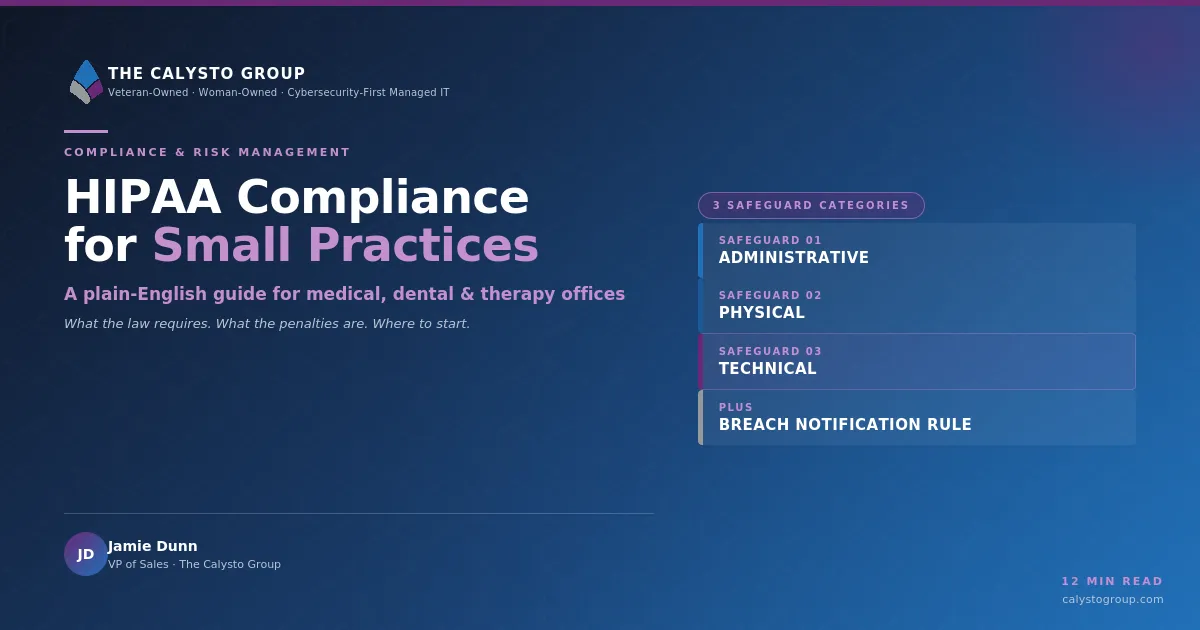
HIPAA Compliance Guide for Small Practices
HIPAA Compliance, Small Healthcare Practices, Cybersecurity Safeguards, PHI Protection
A Practical HIPAA Compliance Guide for Small Medical, Dental, and Healthcare-Adjacent Practices
Small practices face the same HIPAA Compliance obligations as large health systems, but often with a fraction of the staff and budget. This practical guide translates HIPAA’s administrative, physical, and technical requirements into clear, actionable steps tailored for offices with 1–25 providers, so you can strengthen PHI Protection, close Compliance Gaps, and be ready when regulators or patients ask tough questions.
Why HIPAA Compliance Matters Even More for Small Healthcare Practices
Many independent medical, dental, behavioral health, and allied practices still assume regulators focus on hospitals and health systems. In reality, the Office for Civil Rights (OCR) has made clear that small healthcare practices are a primary enforcement target. Recent analyses show that more than half of OCR’s financial penalties have involved small or independent providers, often solo or small-group practices.
At the same time, cybercriminals increasingly view smaller organizations as “soft targets” with valuable data and weaker Cybersecurity Safeguards. A single ransomware attack or lost laptop can trigger reportable breaches, regulatory investigations, reputational damage, and weeks of operational disruption. For a 1–25 provider practice, that can be existential risk—not just a compliance headache.
📌 Key Takeaway: From OCR’s perspective, a two-physician practice and a 2,000-physician system both have the same core HIPAA obligations. Smaller size does not equal lighter requirements.
What HIPAA Actually Requires from an IT and Cybersecurity Standpoint
HIPAA’s Security Rule is often described in legal terms, but it boils down to one central idea: protect electronic protected health information (ePHI) from reasonably anticipated threats and improper uses or disclosures. It does this through three categories of safeguards—administrative, physical, and technical—that every covered entity and business associate must implement. Recent updates effective in 2026 have made many previously “addressable” controls fully mandatory, raising the bar for Small Healthcare Practices.
1. Administrative Safeguards: Governance, Risk, and Training
Administrative safeguards are the policies, procedures, and oversight that guide how your practice manages PHI Protection. OCR’s enforcement priorities make it clear that these are non-negotiable:
Security Risk Analysis and Risk Management: You must regularly identify where ePHI lives (systems, devices, cloud services), assess threats and vulnerabilities, and document a plan to reduce those risks. OCR has imposed dozens of penalties specifically tied to missing or outdated risk analyses and lack of follow-through on mitigation.
Assigned Security Responsibility: Someone in your organization—or a trusted partner—must be clearly designated to oversee HIPAA Compliance and Cybersecurity Safeguards. In small practices, this is often a practice manager supported by an IT or compliance vendor.
Policies, Procedures, and Workforce Training: Written policies must reflect how your practice actually works, from access control and password standards to incident response and portable device use. Staff must receive initial and ongoing training, with attendance and content documented. Many common Compliance Gaps Calysto sees in audits start with outdated or “copy-paste” policies no one follows in practice.
Contingency Planning: HIPAA expects you to plan for outages and disasters. This includes data backup, disaster recovery, and an emergency operations plan. Under new guidance, covered entities are expected to be technically able to restore ePHI within roughly 72 hours of a serious incident such as ransomware.
2. Physical Safeguards: Protecting Devices, Facilities, and Paper
Physical safeguards address how you secure the spaces and devices where PHI is stored or accessed. For a small practice, this is often where low-cost, high-impact improvements can drastically reduce risk:
Facility Access Controls: Limit who can access server rooms, networking closets, and areas where charts or printed PHI are stored. This may include locked doors, visitor sign-in, and escort policies for vendors and contractors.
Workstation and Device Security: Ensure screens are not visible to waiting rooms or hallways, implement privacy screens where needed, and enforce automatic screen lockouts after short periods of inactivity. Laptops and tablets that leave the office should have full-disk encryption and secure storage requirements after hours.
Secure Disposal: Shred paper records and labels, and use certified destruction services for hard drives and other media. Improper disposal remains a frequent root cause of reportable breaches and OCR settlements.
3. Technical Safeguards: The Core of Cybersecurity for ePHI
Technical safeguards are the controls most people associate with “IT security.” Updates to the Security Rule and OCR guidance now make several protections explicitly mandatory, not optional. For Small Healthcare Practices, these are the non-negotiable basics:
Unique User Identification and Access Controls: Every user must have a unique login. Shared usernames (like “frontdesk”) are a clear Compliance Gap and make it impossible to track who did what. Role-based access should limit staff to the minimum PHI they need to perform their job (the “minimum necessary” standard in action).
Multi-Factor Authentication (MFA): MFA is now an expected baseline, especially for remote access, cloud EHRs, email, and VPNs. It significantly reduces the risk of compromised passwords leading to breaches.
Encryption in Transit and at Rest: Encryption for ePHI is no longer treated as simply “addressable.” Regulators now expect robust encryption on servers, laptops, mobile devices, backups, and network connections, including secure email or secure portals for PHI exchange. When properly implemented, encryption can mean the difference between an incident and a reportable breach.
Audit Controls and Logs: Systems that store or process ePHI must generate logs showing who accessed which records, when, and from which device or location. OCR expects practices to be able to produce at least several months of detailed logs during an investigation or audit, and to review them in response to suspicious activity or complaints.
Automatic Logoff and Session Timeouts: Workstations and EHR sessions should automatically log out or lock after a period of inactivity. This helps prevent unauthorized viewing when staff step away from their desks or exam rooms.

Multi-factor authentication and unique logins are now baseline expectations for HIPAA-secure access.
HIPAA “Compliant” vs. HIPAA-Secure: Why the Difference Matters
Many vendors advertise themselves as “HIPAA compliant,” and many practices consider compliance a checkbox exercise—sign a few forms, buy a secure email solution, and move on. In reality, there is a meaningful difference between being technically compliant on paper and being HIPAA-secure in practice.
HIPAA compliant usually means you have policies, Business Associate Agreements, and documented processes that align with the rules. It focuses on documentation and formal requirements. You may pass an initial checklist, but still have weak day-to-day security.
HIPAA-secure means your technical, physical, and administrative safeguards are actually implemented, tested, and effective. Staff follow the procedures, systems are hardened, and you continuously monitor and improve your controls as threats evolve.
OCR enforcement trends show that when a breach occurs, investigators look beyond whether you “had a policy” and focus on whether you actually managed risk, trained staff, monitored logs, and acted on known weaknesses. For Small Healthcare Practices, investing in HIPAA-secure operations—rather than minimum viable compliance—is the most effective way to reduce both regulatory and cyber risk.
💡 Pro Tip: When evaluating vendors, ask them to explain how they help you remain HIPAA-secure, not just HIPAA compliant. Look for evidence of encryption, logging, incident response, and independent security assessments.
The Rise of OCR Enforcement Against Small Practices
Since launching its Risk Analysis Initiative and expanding its Right of Access enforcement, OCR has steadily increased actions against small and independent practices. Enforcement data through 2025 shows that solo providers, small clinics, and therapy practices account for a disproportionate share of settlements and civil monetary penalties—often in the low- to mid-six-figure range, but still devastating for a small office.
Recent enforcement themes that directly affect small practices include:
Missing or outdated Security Risk Analyses: OCR expects a current, documented risk analysis and evidence that you are actively addressing identified risks. A one-time assessment from years ago is no longer acceptable.
Right of Access failures: Dozens of cases involve practices that delayed or overcharged for patient record requests. Even a single complaint can trigger an investigation and settlement if you cannot demonstrate timely, compliant responses.
Vendor and Business Associate oversights: OCR has doubled down on enforcement against business associates, but still holds covered entities responsible for vetting their vendors, executing Business Associate Agreements, and monitoring vendor security practices.
With OCR also beginning civil enforcement of 42 CFR Part 2 confidentiality rules for substance use disorder records as of February 16, 2026, small practices that handle SUD data face an even higher bar for privacy and security. This includes updated Notices of Privacy Practices (NPPs) that explain redisclosure risks and SUD-specific protections.
What a HIPAA Breach Really Looks Like
In HIPAA terms, a breach is more than just a hacking incident. It is defined as an impermissible use or disclosure of unsecured PHI that compromises the security or privacy of that information. “Unsecured” generally means the PHI was not properly encrypted or otherwise rendered unreadable to unauthorized individuals. Common breach scenarios for Small Healthcare Practices include:
A lost or stolen unencrypted laptop containing patient records or access to your EHR.
Ransomware that encrypts your systems and exfiltrates patient data, or for which you cannot demonstrate that no data were accessed or taken.
An employee snooping in records of friends, family, or local public figures without a legitimate need to know.
Misconfigured web forms, tracking pixels, or patient portals that send PHI to third parties (for example, analytics or advertising platforms) without proper safeguards or authorization.
When a potential breach occurs, you must conduct a risk assessment to determine whether the incident is likely to have compromised PHI. If it meets the definition of a breach, you must notify affected individuals, OCR, and in some cases the media, within specific timelines. Delayed or incomplete breach notifications are themselves frequent Compliance Gaps and can lead to additional penalties.
📌 Key Takeaway: Strong encryption, access controls, and logging can prevent many incidents from becoming reportable breaches—and provide the evidence you need if OCR comes calling.
Business Associate Agreements: Your First Line of Defense with Vendors
Any vendor that creates, receives, maintains, or transmits PHI on your behalf is a Business Associate. This includes EHR providers, billing companies, cloud storage services, IT support firms, secure messaging platforms, telehealth tools, and even some marketing or analytics services. HIPAA requires you to have a written Business Associate Agreement (BAA) with each of these vendors before they handle PHI.
A robust BAA should:
Clearly define the permitted uses and disclosures of PHI by the vendor.
Require the vendor to implement appropriate administrative, physical, and technical safeguards, including encryption, access controls, and audit logs, consistent with HIPAA’s Security Rule.
Obligate the vendor to report breaches and security incidents to your practice within a defined timeframe and to cooperate with investigations and notifications.
Address subcontractors, data return or destruction at contract end, and the vendor’s responsibilities in the event of OCR investigations.
OCR’s recent actions against business associates underscore that vendors themselves can be directly liable for HIPAA violations. However, Small Healthcare Practices remain responsible for choosing reputable vendors, executing BAAs, and documenting vendor due diligence. “Our vendor said they were HIPAA compliant” is not a defense if a poorly chosen partner causes a major breach.
Foundational Technical Controls Every Small Practice Should Implement
While every environment is unique, Calysto’s work with small medical, dental, and healthcare-adjacent organizations shows a consistent set of foundational technical controls that dramatically improve PHI Protection and reduce Compliance Gaps. At minimum, your practice should have the following in place:
Encryption Everywhere PHI Lives or Moves
At rest: Full-disk encryption on laptops, tablets, and desktops that store or can access ePHI; encrypted databases and storage volumes for servers and cloud services; encrypted backups (including offsite or cloud-based backups).
In transit: Encrypted connections (HTTPS/TLS) for patient portals and EHR access; secure VPNs for remote work; secure email solutions or patient portals for transmitting PHI, rather than standard, unencrypted email.
Strong Access Controls and Identity Management
Enforce unique user IDs, strong passwords, and MFA for all critical systems (EHR, email, remote access, cloud storage).
Implement role-based access so staff only see the PHI necessary to do their jobs; promptly disable accounts when staff leave or change roles.
Audit Logs and Continuous Monitoring
Ensure your EHR, practice management, and key systems log user access, changes, exports, and administrative actions. Confirm how long logs are retained and how they can be exported for review or investigation.
Establish simple procedures for reviewing logs in response to complaints, suspicious activity, or randomly on a periodic basis. OCR expects that you can show more than just that logs exist—you should be able to demonstrate how you use them.
Reliable Backup and Rapid Restoration
Maintain at least one encrypted, offsite or cloud-based backup of critical systems and data. Test restores regularly to confirm backups actually work and meet the emerging 72-hour restoration expectation after a major outage or ransomware attack.
Document your disaster recovery and business continuity procedures, including who to call (IT, vendors, legal), how to communicate with patients, and how to prioritize restoration of key systems.
Secure Email and Patient Communication
Use secure email platforms or patient portals that encrypt PHI in transit and at rest, and that support BAAs with your email provider. Standard consumer email accounts without encryption or BAAs are not appropriate for PHI.
Train staff on when and how to send PHI securely, and on acceptable use of texting, messaging apps, and telehealth tools. Many Compliance Gaps arise when well-meaning staff default to convenience tools that are not configured for HIPAA Compliance.
The Most Common Compliance Gaps Calysto Sees in Small Practice Audits
Across dozens of HIPAA Compliance assessments for Small Healthcare Practices, Calysto consistently encounters a familiar set of weaknesses. Addressing these areas will put your organization ahead of many peers and significantly reduce your exposure:
Outdated or Incomplete Security Risk Analyses: Many practices have never conducted a formal risk analysis, or they rely on a brief questionnaire completed years ago. Current OCR expectations require a thorough, documented assessment of systems, data flows, vulnerabilities, and mitigation plans—updated regularly as technology and risks change.
“Shelfware” Policies No One Follows: It is common to find generic policy templates that do not match actual workflows. For example, a policy might require quarterly access reviews or annual incident response drills, but there is no evidence these activities ever occurred. OCR views this as a serious Compliance Gap because it shows a disconnect between written and operational practices.
Weak Access Controls and Shared Logins: Shared user accounts, lack of MFA, and failure to promptly disable former staff accounts are still widespread. These gaps make it difficult to investigate incidents and are often cited in enforcement actions involving snooping or unauthorized access.
Insufficient Vendor Management and Missing BAAs: Practices frequently discover that long-standing IT support firms, cloud backup providers, or niche software tools never signed Business Associate Agreements. Even when BAAs exist, there may be no documented vetting of vendor security or understanding of where patient data actually resides.
Inadequate Encryption and Device Management: Unencrypted laptops, personal devices used for work without mobile device management, and legacy servers without modern encryption are common. These issues are often at the heart of reportable breaches tied to lost or stolen devices and ransomware incidents.
Poor Logging and Monitoring: Even when systems technically generate logs, practices may not retain them long enough or know how to access them. There is often no process for investigating anomalous access or responding to patient complaints about privacy violations using audit logs as evidence.
Gaps in Training and Incident Response: Staff may receive basic HIPAA training at onboarding, but there is little ongoing reinforcement or scenario-based practice. When an incident occurs, teams are unsure whom to notify, how to preserve evidence, or how to determine whether the event is a reportable breach.
💡 Pro Tip: Use this list as a self-audit checklist. If any of these Compliance Gaps sound familiar, prioritize them in your next Security Risk Analysis and remediation plan.
Turning HIPAA Requirements into a Practical Roadmap for Your Practice
HIPAA Compliance can feel overwhelming for small medical, dental, and healthcare-adjacent practices, but it becomes manageable when you break it into deliberate, achievable steps. A practical roadmap might look like this:
Start with a Current Security Risk Analysis: Map your systems, data flows, and vendors; identify threats and vulnerabilities; and prioritize remediation. This is the foundation OCR expects and the best way to uncover hidden risks before attackers—or auditors—do.
Close High-Impact Technical Gaps: Implement encryption, MFA, unique logins, and reliable backups first. These controls address the most common and most damaging cyber threats facing Small Healthcare Practices today.
Refresh Policies, Training, and Incident Response: Align your written policies with reality, train your team on both Privacy Rule and Security Rule responsibilities, and rehearse your incident response plan so everyone knows what to do when something goes wrong.
Strengthen Vendor and BAA Management: Inventory all vendors that touch PHI, ensure BAAs are in place, and document the security assurances and configurations you rely on. Pay special attention to web tracking tools, telehealth platforms, and cloud-based services that may not look like traditional “health IT” but still handle PHI.
Commit to Continuous Improvement: HIPAA Compliance is not a one-time project. Schedule regular reviews of your risk analysis, logs, training, and vendor list. Monitor regulatory updates—such as the 2026 NPP changes and evolving Security Rule expectations—and adjust your program accordingly.
By focusing on both the letter and the spirit of HIPAA—combining documented compliance with real-world Cybersecurity Safeguards—you can protect your patients, your reputation, and the long-term viability of your practice. For small organizations, that combination of PHI Protection and operational resilience is not just a regulatory requirement; it is a strategic advantage in an increasingly digital, risk-conscious healthcare landscape.