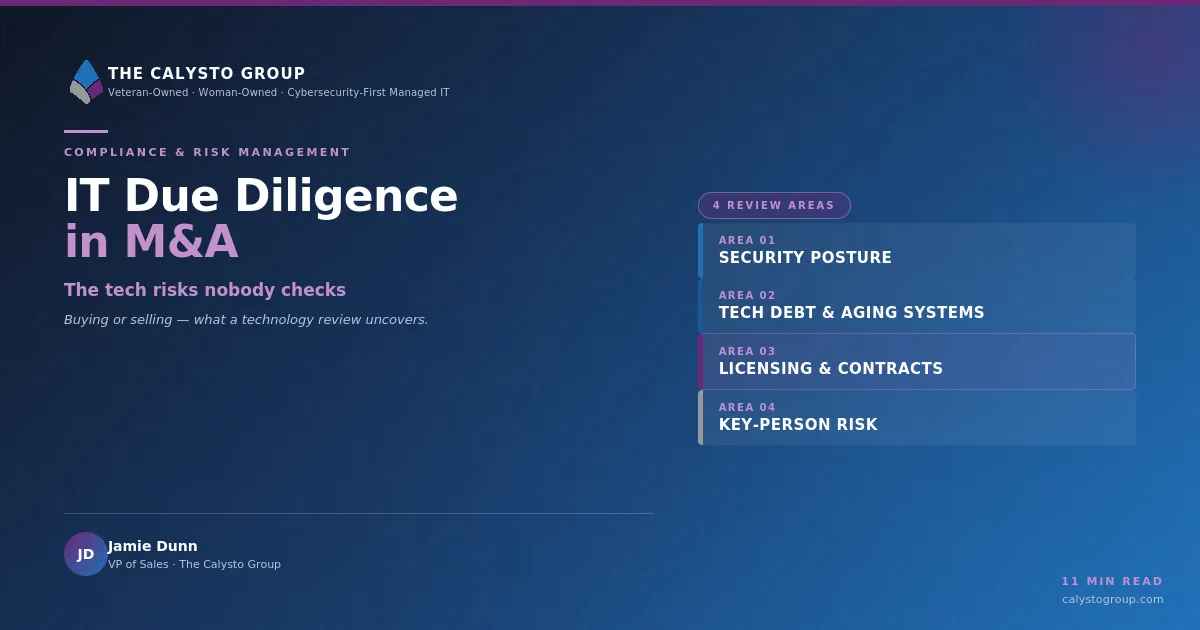
IT Due Diligence in M&A
When a business is bought or sold, the diligence process is thorough about the things everyone knows to check. The financials are examined line by line. The contracts are reviewed. The legal exposures are catalogued. And then, remarkably often, technology is treated as an afterthought — a box checked with a quick question about whether the systems work.
That gap is where expensive surprises live. The technology environment of a business carries real risk and real value, and whether you are buying or selling, a proper technology review can change the price, the terms, or the wisdom of the deal itself. IT due diligence is not a formality. It is one of the more consequential examinations in the entire transaction, and it is the one most often shortchanged.

Why technology deserves real scrutiny in a deal
A business runs on its technology, and the condition of that technology is inseparable from the condition of the business. A company might show healthy financials while sitting on aging infrastructure, unaddressed security exposure, and systems held together by one irreplaceable person. None of that appears on the balance sheet, and all of it becomes the buyer’s problem the moment the deal closes.
For a buyer, the technology review answers a critical question: what am I actually acquiring, and what will it cost me to make it sound? For a seller, the same review answers a different one: where are the weaknesses that will surface in the buyer’s diligence, and can I address them before they cost me leverage? Either way, the examination pays for itself.
The technology risks nobody checks in a deal are exactly the ones that become someone’s expensive problem after it closes. Diligence is cheaper than the surprise.
— Jamie Dunn, VP of Sales
Four areas a technology review examines
Security posture. The first question is what shape the security is in — and whether there has been an incident that has not been disclosed or fully understood. A business that has suffered a breach may carry liabilities that follow the acquisition. Beyond history, the review assesses whether the security controls are adequate for the business and its industry, because a buyer inheriting weak security is inheriting the cost of fixing it and the risk until they do.
Technology debt and aging systems. Every business accumulates technology debt — deferred upgrades, aging equipment, systems running past their sensible life. The review quantifies it, because that debt is a real cost that the buyer will have to pay, often sooner than they expect. A business that looks profitable may be profitable partly because it has been starving its technology, and that deferred cost is about to come due.
Licensing and contracts. Software licensing is a frequent source of post-deal surprises. Businesses run on software, and that software carries licensing terms, renewal obligations, and sometimes compliance exposure if it has been used outside its terms. Vendor contracts may have change-of-control clauses, unfavorable renewals, or commitments that outlast their usefulness. The review surfaces what the business is actually obligated to and what those obligations will cost.
Key-person risk. In many small businesses, critical technology knowledge lives in one person’s head. If that person does not come with the acquisition — or leaves shortly after — the buyer may find that no one knows how the environment actually works. The review identifies these single points of failure, because a business whose technology only one person understands carries a risk that no financial statement will reveal.

For sellers: diligence before the buyer does it
If you are preparing to sell, the most valuable thing you can do is run this review on yourself before the buyer’s team does. The buyer’s diligence will find your weaknesses. Finding them first lets you address what you can, prepare honest explanations for what you cannot, and avoid the loss of leverage that comes when a buyer discovers a problem you did not disclose.
A well-documented, well-run technology environment is also a selling point in its own right. It signals a business that has been managed with discipline, and it removes a category of buyer anxiety that can otherwise drag down price or stall a deal. The same qualities that make technology sound also make it saleable.
For buyers: know what you are inheriting
If you are buying, resist the temptation to treat technology as a quick check. Bring in someone who can actually assess the environment — the security, the debt, the contracts, the key-person risk — and factor what they find into your valuation and your terms. The cost of a proper technology review is trivial next to the cost of discovering, after closing, that you bought a business whose systems need a six-figure overhaul or whose only competent administrator just left.
Ask your current MSP or advisor:
- If we were acquiring a business, who would assess its technology environment, and how thoroughly?
- If we were selling, what would a buyer’s technology diligence uncover about us?
- Where does critical knowledge about our systems live, and what happens if that person leaves?
Mergers and acquisitions are decided on numbers, but the numbers do not tell the whole story. The technology environment carries risk and value that the financials do not capture, and the diligence process routinely underweights it. Give technology the same scrutiny you give the balance sheet, whether you are on the buying or the selling side, and you replace one of the deal’s largest blind spots with clarity. In a transaction where surprises are expensive, that clarity is worth a great deal.
The Calysto Group is a veteran-owned, woman-owned, cybersecurity-first managed IT firm serving businesses across Michigan from offices in Saint Clair and Troy. If you are preparing to buy or sell and want technology given its proper weight in the process, we can help.