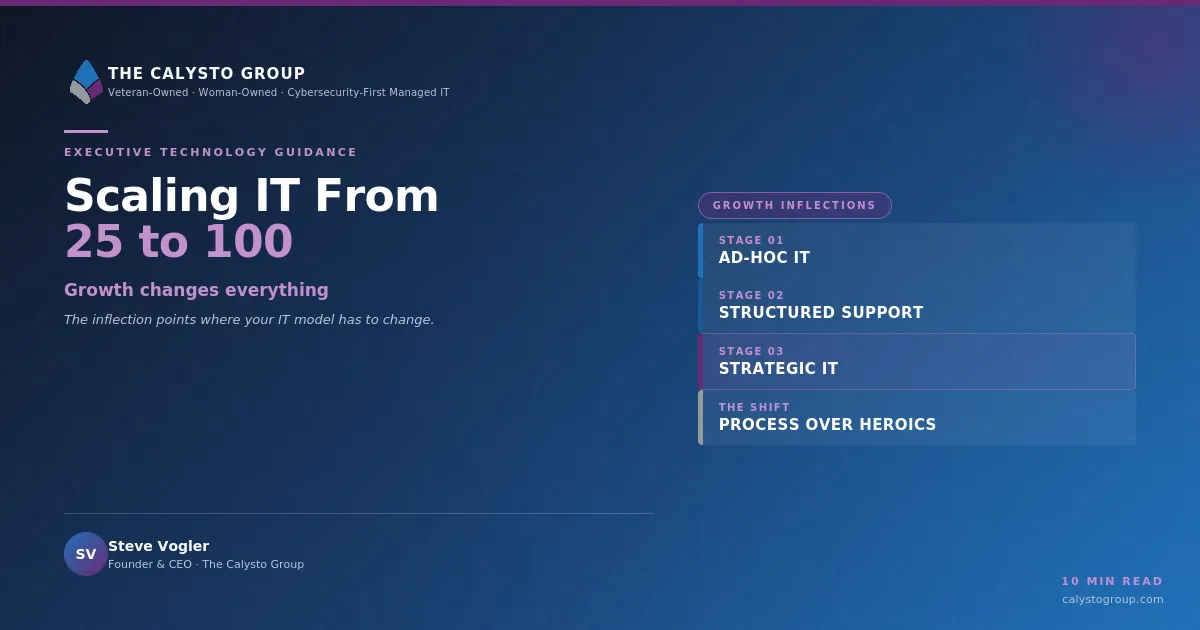
Scaling IT From 25 to 100 Employees
The technology approach that carries a business comfortably at twenty-five employees will actively hold it back at a hundred. This surprises people, because the systems did not break — they simply stopped fitting. What worked did not fail so much as it quietly became the thing slowing everyone down.
Growth is not just more of the same. It is a series of thresholds, and at each one the way you handle technology has to change. Businesses that recognize these inflection points and adapt ahead of them scale smoothly. Businesses that do not find that technology becomes a drag on exactly the growth they worked so hard to achieve. Understanding where the thresholds sit is how you stay ahead of them.

Why the model has to change as you grow
At a small scale, technology can run on heroics. One capable person — an owner, an office manager, a technically inclined employee — keeps things working through personal effort and accumulated knowledge. Decisions get made informally. Problems get solved by the person who knows how. It works because the business is small enough for one person to hold in their head.
That model has a ceiling, and the ceiling arrives sooner than most expect. As headcount grows, the informal approach starts to strain. The one person who knows everything becomes a bottleneck. Undocumented decisions become a liability. The absence of process, which felt like agility at twenty-five people, starts to feel like chaos at sixty. The business has not done anything wrong. It has outgrown its technology model, and the model has to evolve.
Growth does not break your systems. It outgrows them. The businesses that scale well are the ones that see the next threshold before they hit it.
— Steve Vogler, Founder & CEO
Three stages of IT maturity
Stage one: ad-hoc. In the earliest stage, IT is reactive and informal. Someone handles problems as they arise. There is little documentation, little process, and heavy reliance on individual knowledge. This is entirely appropriate for a small business, and trying to impose heavy structure too early is its own mistake. The ad-hoc stage works — until the business grows past the point where one person’s knowledge and effort can cover it.
Stage two: structured support. As the business grows, it needs structure. This means documented processes so that knowledge does not live in one head. It means a real support system so that problems are handled consistently rather than depending on who is available. It means standardized equipment and configurations so that the environment is manageable at scale. The shift to structured support is the first major inflection point, and it is the one businesses most often hit unprepared, because the ad-hoc approach worked for so long that its limits arrive as a surprise.
Stage three: strategic IT. At larger scale, technology needs not just to work reliably but to be planned and aligned with the business. This is where roadmaps, budgets, and strategic guidance become essential — where someone is thinking about where technology needs to go, not just keeping it running. Strategic IT is what allows a growing business to make deliberate technology decisions that support its trajectory rather than reacting to whatever breaks next.
The progression matters. You cannot run strategic IT on an ad-hoc foundation, and trying to skip the middle stage is how businesses end up with sophisticated plans sitting on top of chaos.

The shift that underlies all of it: process over heroics
If there is a single theme to scaling technology, it is the move from depending on people to depending on process. At small scale, heroics work — the right person, working hard, keeps everything going. At larger scale, heroics become a liability, because they do not scale and they create single points of failure. What replaces them is process: documented, repeatable ways of doing things that do not depend on any one person being present and knowledgeable.
This shift is often uncomfortable, because the heroics were genuinely valuable and the people who performed them are often central to the business. But the goal is not to diminish those people. It is to capture what they know in a form the whole organization can rely on, so that the business is not one resignation away from not knowing how its own systems work. That is not a knock on the hero. It is how you protect the business and the hero both.
Getting ahead of the thresholds
The businesses that scale well share a habit: they anticipate the next stage before they are forced into it. They document while the environment is still small enough to document easily. They build structure before the lack of it becomes painful. They bring in strategic thinking before technology becomes a constraint on growth.
Ask your current MSP or IT lead:
- Which stage of IT maturity are we in, and which one is our growth about to require?
- Where does critical technology knowledge live, and is it documented or in someone’s head?
- What should we be putting in place now to support where the business will be in two years?
Scaling a business is hard-won, and it would be a shame to let technology become the thing that caps it. The systems and approaches that served you well at one size are not failures when they stop fitting at the next — they are simply signs that the business has grown, and that its technology model needs to grow with it. Recognize the thresholds, adapt ahead of them, and technology becomes what it should be as you scale: a support for growth rather than a brake on it.
The Calysto Group is a veteran-owned, woman-owned, cybersecurity-first managed IT firm serving businesses across Michigan from offices in Saint Clair and Troy. If your business is growing and your technology is starting to feel like a constraint, that is exactly the conversation we are built for.
