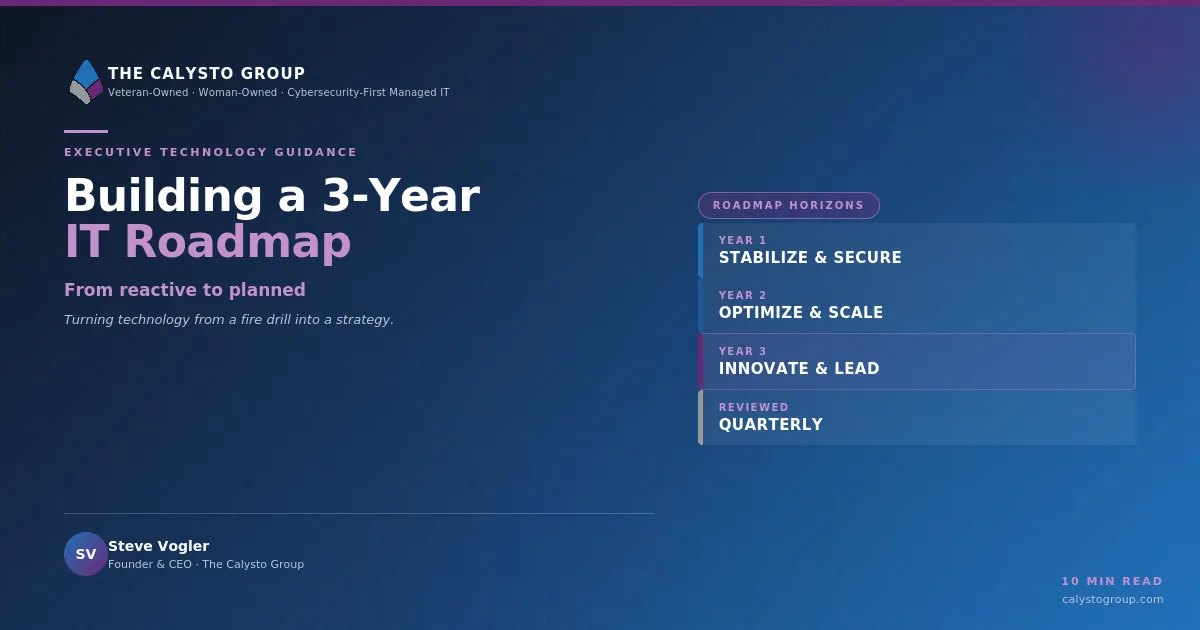
Building a 3-Year IT Roadmap
Most small and mid-sized businesses manage technology the way you would manage a leaking roof with a bucket. Something breaks, you deal with it. A machine dies, you replace it. A problem becomes urgent, it gets attention. The rest of the time, technology is invisible until it demands otherwise.
This reactive posture is understandable. It is also expensive, and it quietly caps how fast and how confidently a business can grow. The alternative is not complicated, but it does require a shift in thinking: from treating technology as a series of emergencies to treating it as a plan. That plan is an IT roadmap, and building one is among the highest-leverage things a growing business can do.

What an IT roadmap actually is
An IT roadmap is a multi-year plan that aligns your technology decisions with your business goals. It looks ahead — typically three years — and lays out what needs to happen, in what order, and roughly when. It turns the scattered, reactive stream of technology decisions into a deliberate sequence that supports where the business is trying to go.
The value is not in predicting the future perfectly. It is in replacing surprise with intention. When you have a roadmap, a server reaching end-of-life is not an emergency purchase in a panic — it is a line item you saw coming a year ago and planned for. A security upgrade is not a scramble after an incident — it is a scheduled step. The roadmap does not eliminate change. It removes the surprise from it.
A roadmap does not predict the future. It removes the surprise from it — which is most of what makes technology feel expensive and chaotic.
— Steve Vogler, Founder & CEO
A three-year horizon, in three movements
A useful way to think about a roadmap is in three phases, each building on the last.
Year one: stabilize and secure. The first year is about foundation. Before you can build toward ambitious goals, the basics have to be solid and safe. This means closing security gaps, ensuring backups are tested and reliable, bringing systems up to a consistent standard, and documenting the environment so that knowledge does not live in one person’s head. Year one is unglamorous and essential. It is the year that makes everything after it possible.
Year two: optimize and scale. With a stable foundation, the second year turns to efficiency and growth. This is where you improve the systems people use daily, remove the friction that slows work down, and put in place the infrastructure that will support a larger business. Year two is where technology stops being a cost center that keeps the lights on and starts being a lever that makes the business run better.
Year three: innovate and lead. By the third year, with strong foundations and optimized operations, you have the freedom to pursue advantage. This is where new capabilities — better data, new tools, competitive differentiators — become realistic, because the business is no longer spending all its energy keeping the basics running. Year three is where technology becomes offense rather than defense.
These phases are a framework, not a straitjacket. The point is the progression: you cannot innovate on an unstable foundation, and a roadmap keeps you from trying.

Why the roadmap has to connect to the business
A technology roadmap built in isolation from business goals is just a shopping list. The value comes from the alignment.
If the business plans to double its headcount, the roadmap needs to account for the systems and infrastructure that growth requires. If a new location is coming, the technology to support it has to be sequenced ahead of the opening, not scrambled together after. If the business is preparing for a possible sale or acquisition in a few years, the roadmap should be building the documented, well-run environment that survives due diligence. The roadmap is where business strategy and technology strategy meet, and that meeting is what makes it worth building.
This is also why a roadmap is a living document rather than a one-time exercise. Business plans change. A good roadmap is reviewed regularly — quarterly is a sensible rhythm — so that it stays connected to reality rather than becoming a plan for a business that no longer exists.
Getting started without overcomplicating it
You do not need a hundred-page document. You need a clear-eyed assessment of where you are, an honest statement of where the business is trying to go, and a sensible sequence connecting the two.
Start with an inventory of your current state: what systems you have, what condition they are in, where the risks and the aging equipment sit. Then bring in the business direction: growth plans, new initiatives, anything on the horizon that technology will need to support. The roadmap is the bridge between those two pictures.
Ask your current MSP:
- Do we have a documented technology roadmap for the next two to three years?
- When did we last review our technology plan against our current business goals?
- What is coming that we should be planning for now, rather than scrambling for later?
The businesses that handle technology well are almost never the ones that react fastest to emergencies. They are the ones that have fewer emergencies, because they saw them coming and planned around them. A roadmap is how you get there. It converts technology from a source of surprise expense and disruption into a planned, budgeted, strategic part of how the business grows. That shift — from bucket-under-the-leak to a plan for the roof — is one of the clearest signs of a business maturing from surviving to scaling.
The Calysto Group is a veteran-owned, woman-owned, cybersecurity-first managed IT firm serving businesses across Michigan from offices in Saint Clair and Troy. If you would like help building a technology roadmap that connects to your business goals, that is a conversation we have often.
