What a vCIO Actually Does
Most small and mid-sized businesses have someone who fixes their technology. Far fewer have someone who thinks about it. That distinction — between keeping technology running and steering where it goes — is the gap a vCIO fills, and it is one of the most misunderstood roles in the technology world.
A virtual CIO, or vCIO, brings executive-level technology leadership to businesses that need the thinking but do not need or cannot justify a full-time chief information officer. Understanding what a vCIO actually does, and why it matters, clarifies a question many growing businesses are quietly wrestling with: who is responsible for our technology strategy, as opposed to our technology support?

Support and strategy are different jobs
Most technology relationships are built around support. Something breaks, it gets fixed. A request comes in, it gets handled. This is essential work, and a business cannot run without it. But support answers the question “is our technology working,” and there is a second, larger question that support does not touch: “is our technology taking us where we need to go.”
That second question is strategy, and it is a genuinely different discipline. It is about roadmap and risk, budget and alignment, the decisions that shape what technology does for the business over years rather than the problems that need solving today. A great support team can keep everything running flawlessly and still leave the strategic question entirely unanswered, because answering it was never their job.
The vCIO exists to answer it.
Strategic technology is not measured in tickets resolved. It is measured in decisions made before they became emergencies.
— Steve Vogler, Founder & CEO
What a vCIO actually delivers
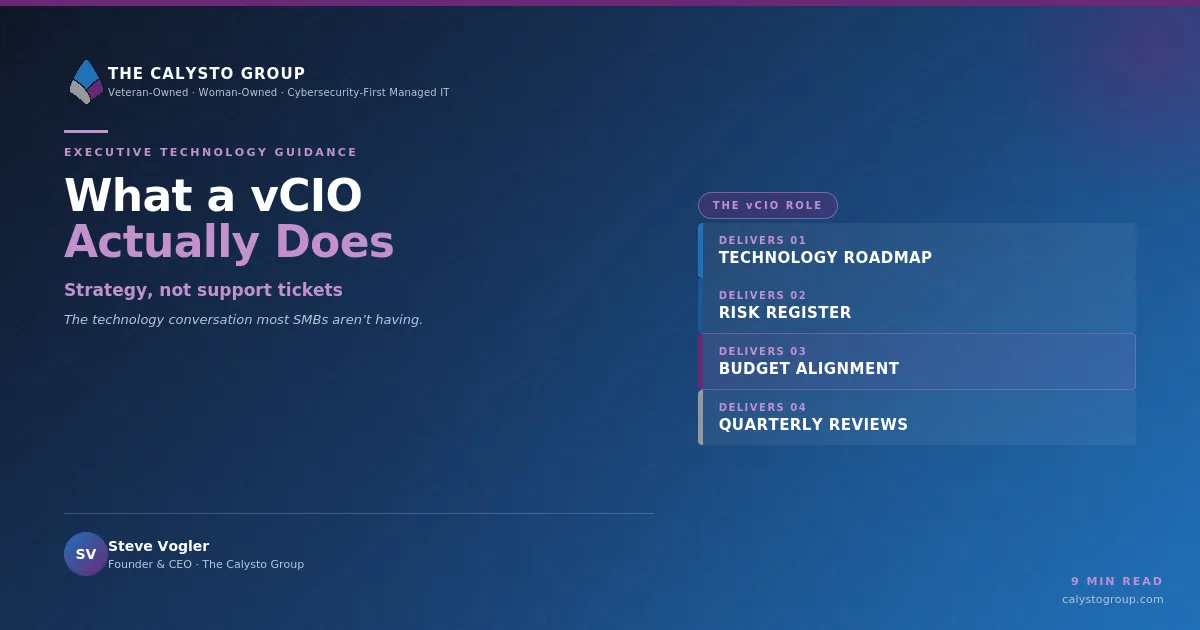
A technology roadmap. The vCIO builds and maintains the multi-year plan that connects technology decisions to business goals. Instead of technology arriving as a series of surprises, it follows a deliberate sequence that supports where the business is heading. The roadmap is the vCIO’s central artifact — the place where business direction and technology planning meet.
A risk register. The vCIO keeps an honest, current view of the technology risks facing the business — security exposures, aging systems, single points of failure, compliance obligations — and ensures they are being addressed in priority order. Most businesses carry risks they have never named. The vCIO names them, ranks them, and makes sure the important ones get attention before they become incidents.
Budget alignment. The vCIO connects technology spending to business value, helping leadership understand what they are paying for and why. This is where the categorized IT budget comes from, where strategic investments get justified, and where the technology number stops being a black box and becomes a managed plan leadership can stand behind.
Regular strategic reviews. Perhaps most importantly, the vCIO brings a cadence of strategic conversation — typically a quarterly business review — where technology is discussed not because something is broken, but because the business is planning ahead. These reviews cover what has changed, what is coming, what decisions need making, and whether the roadmap still fits reality. They are the rhythm that keeps technology strategic rather than reactive.

Why “virtual” makes it accessible
A full-time CIO is a significant expense, and for most small and mid-sized businesses, the workload does not justify a dedicated executive. But the need for the thinking does not disappear just because the business is not large enough to hire for it full-time. That is the gap the virtual model closes.
A vCIO delivers the strategic leadership on a fractional basis — the roadmap, the risk oversight, the budget alignment, the quarterly reviews — without the cost of a full-time executive. The business gets executive-level technology thinking scaled to its actual needs. This is what makes the role accessible to businesses that would never otherwise have access to CIO-level guidance, and it is often the difference between technology that is merely maintained and technology that is genuinely led.
The sign that you need one
There is a simple diagnostic. Think back to your last leadership meeting where technology was on the agenda. Was it there because something had broken, or because you were planning ahead? If the honest answer is that technology only reaches the leadership table as a problem — never as a plan — that is the gap a vCIO fills.
The businesses that handle technology best are not the ones with the largest IT budgets or the newest tools. They are the ones where someone is genuinely thinking about technology strategically — connecting it to the business, anticipating what is coming, and making decisions before they become emergencies. Sometimes that person is a full-time executive. More often, for a growing business, it is a vCIO.
Ask your current MSP:
- Do we have someone providing genuine technology strategy, or only technology support?
- Do we have a documented roadmap and a current risk register, and who maintains them?
- When was our last strategic technology review that was not prompted by something breaking?
Fixing technology and leading technology are different jobs, and a business can be excellent at the first while entirely missing the second. The vCIO fills that gap — bringing the roadmap, the risk oversight, the budget discipline, and the strategic cadence that turn technology from a thing you maintain into a thing that moves the business forward. For a growing business that has plenty of support but no strategy, it is often the most valuable technology role there is.
The Calysto Group is a veteran-owned, woman-owned, cybersecurity-first managed IT firm serving businesses across Michigan from offices in Saint Clair and Troy. Providing vCIO-level guidance to growing businesses is a core part of what we do — if the strategy gap sounds familiar, let us talk.
