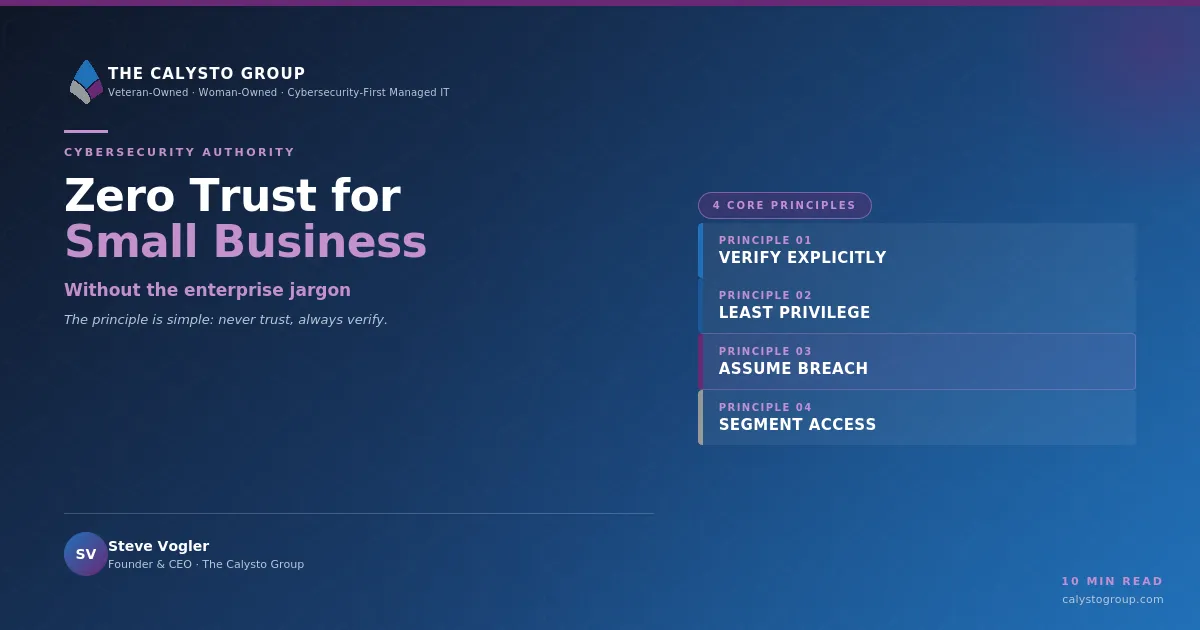
Zero Trust for Small Business, Without the Jargon
Zero Trust has become one of the most used and least understood phrases in cybersecurity. It appears in enterprise marketing, government mandates, and vendor pitches, usually wrapped in enough jargon to make a small-business owner assume it is not meant for them.
It is meant for them. The principle underneath the buzzword is simple, sensible, and entirely achievable at the scale of a growing business. You do not need an enterprise budget to adopt the thinking. You need to understand what the idea actually asks of you.

The old model, and why it stopped working
For years, network security worked like a castle. You built a strong perimeter — a firewall, a corporate network — and everything inside that wall was trusted. Once you were in, you could move freely. The wall did the work.
That model made sense when everyone worked in one office on one network. It makes far less sense now. Your people work from home and from the road. Your data lives in cloud applications you do not host. Your vendors connect to your systems. The wall has so many gates that “inside” and “outside” have stopped meaning very much. And once an attacker gets past the wall through a single stolen password, the old model grants them the same free movement it grants everyone else.
Zero Trust replaces “trust everything inside the wall” with a more durable idea: never trust, always verify.
The principle, in one sentence
Zero Trust assumes that no user and no device should be trusted automatically, regardless of whether they are inside or outside your network. Every request to access something is verified — who is asking, what device they are on, whether they should have access to that specific resource — before it is granted.
That is the whole idea. Everything else is implementation.
Zero Trust is not a product you can buy. It is a principle you apply — verify before granting access, every time, to everyone.
— Steve Vogler, Founder & CEO
Four principles you can actually apply
Verify explicitly. Every access request should be authenticated and authorized based on what you know — the user’s identity, confirmed with strong MFA, and ideally the health of the device they are using. This is the practical heart of Zero Trust, and if you have enforced MFA everywhere it matters, you have already started.
Use least privilege. People should have access to exactly what they need to do their jobs, and nothing more. When someone changes roles, their old access should be removed, not merely added to. When a vendor needs access to one system, they should not receive keys to the building. Least privilege limits how far any single compromised account can reach.
Assume breach. Design as though an attacker will eventually get in — because planning for prevention alone is planning for the day everything works. Assuming breach means segmenting your systems so a compromise in one area cannot automatically spread to all others, and monitoring for unusual activity so you notice when something is wrong.
Segment access. Rather than one flat network where everything can reach everything, separate your systems so that access between them is controlled and deliberate. If an attacker compromises one workstation, segmentation is what stops them from reaching your servers, your backups, and your financial systems in a single move.

What this looks like at small-business scale
You are not building a government network. For most growing businesses, adopting Zero Trust thinking looks like a series of practical, affordable steps.
It means enforcing strong MFA everywhere, so identity is genuinely verified. It means reviewing who has access to what and trimming the accumulation of permissions that builds up over years. It means separating your most sensitive systems from your everyday ones. It means offboarding departed employees promptly and completely. And it means having enough visibility into your environment that unusual activity gets noticed rather than discovered months later.
None of these steps requires an enterprise platform. All of them move you toward a posture where a single stolen password does not hand over the whole business.
Where to begin
Start with identity, because it is the foundation everything else rests on. If you have not already enforced strong MFA across every system that matters, that is step one, and it delivers the largest share of the benefit.
From there, review access. Ask who can reach your most sensitive data and whether each of those people still needs to. The answers are often surprising, and tightening them is usually free.
Ask your current MSP:
- Which of our systems are segmented from each other, and which sit on one flat network?
- When someone leaves or changes roles, how completely and quickly is their access removed?
- If one workstation were compromised, what would stop the attacker from reaching everything else?
Zero Trust is not a purchase, a project with an end date, or a concept reserved for large enterprises. It is a way of thinking about access — verify before you grant it, give people only what they need, and design as though a breach will happen. Applied steadily, at a scale that fits your business, it is one of the most effective postures a growing organization can adopt.
The Calysto Group is a veteran-owned, woman-owned, cybersecurity-first managed IT firm serving businesses across Michigan from offices in Saint Clair and Troy. If you would like help translating Zero Trust from principle into practical steps, we would be glad to talk.
